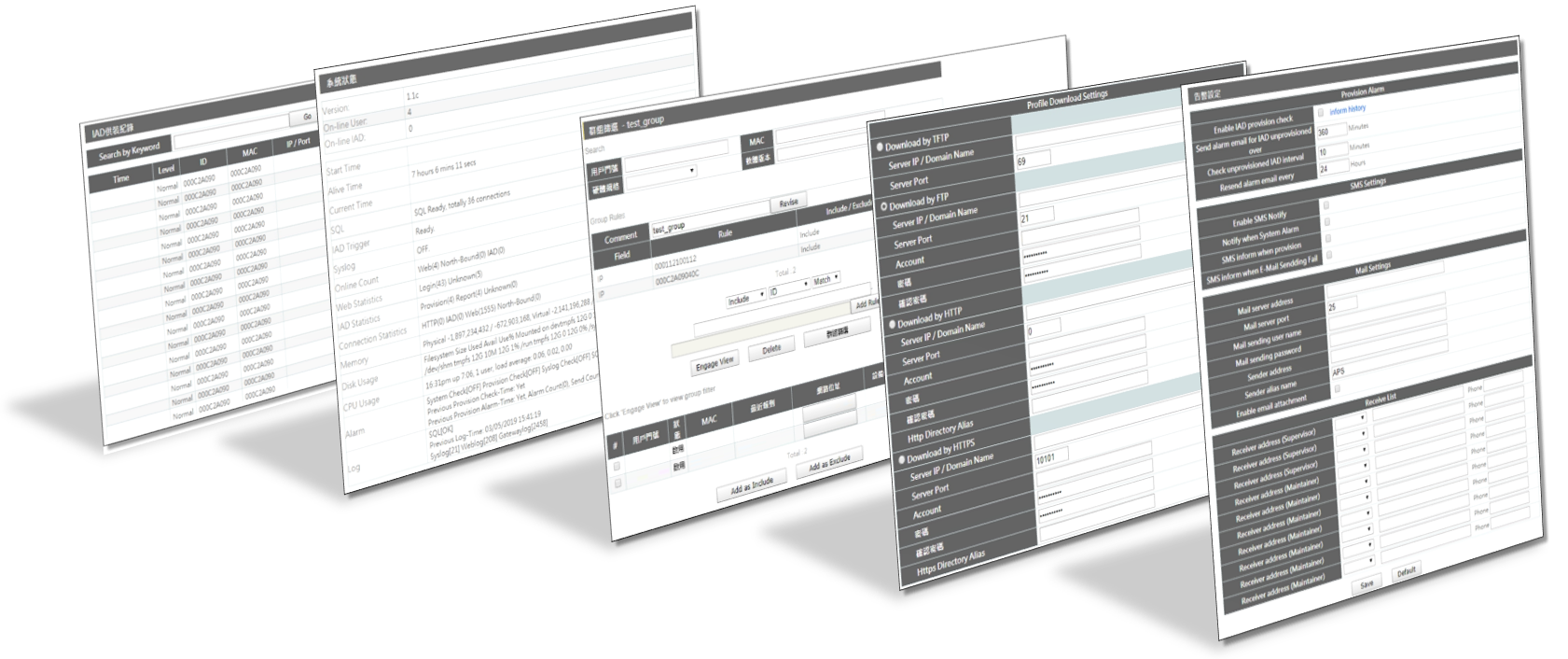
A new generation of Auto Provision System

The new generation of Auto Provision System integrates a large number of provision services for telecommunications terminal equipment, uses the establishment and dispatch process of the rule base to complete the deployment and supply of equipment services, and provides through standardized service architecture and applications. Added modifications and deleted one-stop installation operations, allowing telecommunications service providers to define the configuration required for individual devices, perform driver updates, analyze abnormal statuses, and resolve them quickly remotely.
● Management - Configure device parameters and manage individual devices, groups, profiles, images, and APIs.
● Provisioning - Provide device installation services.
● Monitoring - Monitor device status and send notifications.
● Inspection - View actual device parameter values.
● Statistics - Provide information analysis and reports.
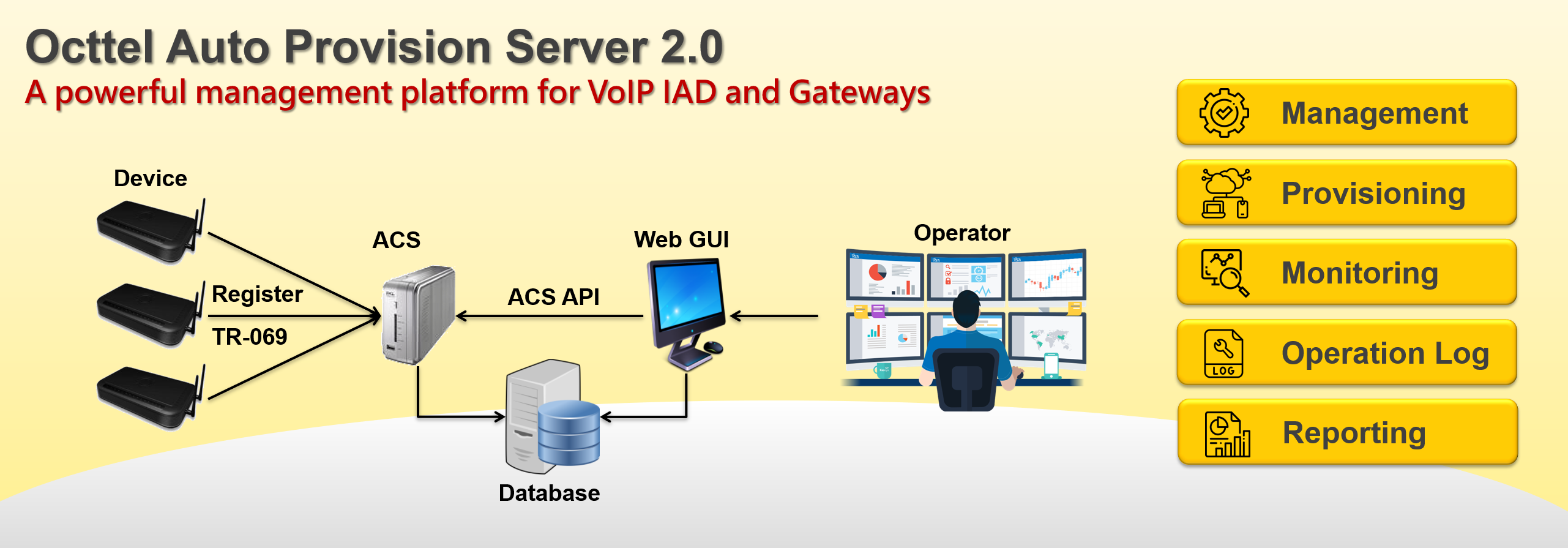
APS 2.0 System Architecture
● APS 2.0 is based on the TR069 protocol.
● The underlying layer is TR069 ACS, and the upper-layer UI can be customized according to customer needs.
● It can provide a standard RESTful (HTTP) protocol API to communicate with customers' existing devices.
Management Functions
● Define the device with OUI, ProductClass, and Serial.
● Groups can be created to set multiple devices at the same time and can be set multiple conditions, such as Tag and MAC being greater than, less than, or equal to certain conditions.
● Profile is provided to speed up the settings of multiple Parameters and can be applied to the device and group settings.
● Parameter settings provide multiple setting methods.
● Customized APIs can be provided for client use.
Provisioning Functions
● Device proactively reports in accordance with the TR069 protocol.
● APS determines whether the device complies with the inform and provides relevant setting values for the device to install.
● Device/ Group can be set to install a certain version of Image. Once the machine reports, if it does not match this version, the firmware will be updated.
● Provide Connect request, reboot, reset and other functions, and record the related information.
Monitoring Functions
● Provides settings to notify the supervisor by email (or other means) when a certain parameter of the device meets a certain value. For example, when the CallState status of the specified machine is Disconnect (that is, a certain Port of the machine is disconnected), a message will be sent to notify the specified monitor at any time.
● Monitoring can set multiple groups at the same time to monitor multiple devices or multiple sets of parameters in a Device.
● Provides quick Group settings to monitor multiple devices that meet the conditions at the same time.
Inspection Functions
● APS can record the settings/ status provided by the device report, completely record it in the database, and provide UI viewing and settings.
● For settings/ status that are not provided when the Device reports, you can ask the device to bring them with it when it reports next time.
Statistical Functions
● Scheduled reports/ analysis for system administrators to understand system status, such as weekly/ monthly reports, providing the number of online or offline devices during this period, the number that has been set but not reported, or the frequency of monitored status occurrences/ Quantity etc.
● Provide device status, connection status, version status, etc., and provide statistical data according to customer needs.